The Inner Room The Inner Room Already bought? Log in

Handed down for centuries, one-on-one, at a table. Not anymore.

At fifty I lost everything. Then I answered a one-line job ad.

The job was driving for an old man from old money. Over the next four years he passed on to me what his father had passed on to him, one piece at a time. What changed wasn't my luck. It was the man making my decisions.

Ninety days. One payment. Thirty days to change your mind, and a full refund on day ninety if you've done the work and nothing has changed.
Who's telling you this

Six years ago I sat by myself in a convention hall that seats five thousand.

It was the day of my biggest event, and the event wasn't happening anymore. The doors were unlocked. The chairs were stacked along the wall. I took one down, set it in the middle of the floor, and sat there for an hour. Five thousand empty chairs don't make a sound.

For ten years I'd stood on stages and taught people how to build a business and a life. I started with forty folding chairs in a hotel conference room off the highway and ended up with rooms of three, four, five thousand. Then it all came apart, from several directions at once, in about ninety days. What was left was debt. I won't go into what happened. It doesn't matter. You've had your own ninety days, or you will.

That night I opened the statements for the first time in ten years. Kitchen table, three in the morning. The house payment. The cards. The business line of credit. Numbers I couldn't say out loud. I still don't say them.

I turned fifty in the middle of all that. My sons brought a cake. I blew out the candles and realized I hadn't wished for anything. I couldn't think of anything to want. That scared me more than the debt.

I'd started over before. The first time I was twenty-six, when my wife and I came to America with a suitcase each and a medical degree nobody here could read. After that it was one business after another. Two good years, three, five, and then the floor would drop out. This time I didn't have another ten years in me.

For four months I sat on the edge of the bed every morning for an hour and couldn't get up. One evening my wife sat down across from me and said, The last time we had nothing, we had you. Where did you go? I didn't know. That was the worst part.

Overqualified, overeducated, over fifty. I heard all three in one month. I took whatever I could find. For a month I delivered food. One night I carried a bag up to a man I recognized right away: he'd sat in my third row for three years. He took the bag without looking up from his phone, said thanks, and shut the door. Nobody looks at the delivery guy.

Then one night, eight months after it all came apart, close to midnight, I saw a one-line job ad. Personal driver needed. Call for details. A phone number and nothing else. I closed the laptop and went to bed. Half an hour later I got up, found the ad again, and wrote the number down.

There was no name on the gate. The owner opened the door himself. He was about seventy-five and sharper than anyone I'd met in years. His first question was: Why did you call? There was nothing in the ad. I gave him the only true answer I had. I don't know. I couldn't sleep. Three days later they called and said I could start.

I drove him for a year. People in the back seat talk like the front seat is empty. He didn't. I'd catch his eye in the mirror, and every day I saw things I couldn't explain.

He never raised his voice. Not once in a year.

A big deal fell through over the phone. He was quiet for a second and said, Good. Now we know. Then he changed the subject.

Every morning, ten minutes into the drive, he took out a small black notebook and wrote down one number. Just one.

He never complained. Not about traffic, not about the weather, not about people.

He knew the gardener's kids by name.

He never talked about his money, and he went quiet whenever somebody bragged about theirs.

At the end of the hall there was a small room, and every morning its door was shut for fifteen minutes. The housekeeper told me, Don't knock. That's his inner room.

After a year he made me his personal assistant, and for three more years he taught me what I'd been watching from the driver's seat without knowing what I was looking at.

The debt was gone by the third year. No miracle, no windfall. A chain of openings, and the man I used to be would have driven right past every one of them.

Nobody looks at the driver. He did.
Why you've never heard of this

For centuries it was handed down one-on-one, at a table.

When he made me his assistant, he told me about his son. He said his son had left him many years ago. He didn't say what that meant, and I didn't ask.

What I'm going to give you has been handed down the same way for centuries, he said. One-on-one, at a table. My father gave it to me at his. My son isn't at mine.

Later I found out that the oldest surviving text on this is written as a father talking to his son. Mine was an old man talking to somebody else's son.

Why it never reached you.

Nobody banned it. Nobody had to. It could only travel up close: one teacher, one student, a piece at a time, with somebody watching you every day for years. His father needed twelve years with him. You can't do that for more than one or two people in a lifetime. So it stayed at a few tables, in a few families, and everybody else got the simple version. Work hard. Be good. Wait your turn.

His family's money is three generations old. Money doesn't make it to the third generation on its own. Without what gets taught at the table, it's usually gone in one. You can watch that happen to anybody who wins the lottery.

Why he did it in three years, not twelve.

He told me he was putting me on an accelerated program. My father needed twelve years with me. I'll do it with you in three.

I asked how. He said times had changed. Time has compressed, and people can take this in far faster than they used to. It goes all the way down to the DNA.

I trained as a doctor a long time ago, and I know how that sounds. I'm telling you what he told me, and what I saw happen to me. It went faster than it had any right to. Things that took him years at his father's table took me months.

Twelve years for him. Three for me. Ninety days for you.

I won't pretend ninety days will give you what four years gave me. But for me, it was the first ninety days that changed the man making my decisions. That's what I can offer you.

And why now.

On my last day he said: You can teach this now. But I want you to do it in a completely new way. Not the way we've done it for centuries. These are new times, and everything has to be new. It's time this belonged to a great many people.

For centuries it needed a table, because it needed someone who'd watch you every morning and wouldn't let you skip. That's the part that has changed. The watching no longer needs him in the room.

I'll never tell you his name or where he lives. What he taught me, he told me to pass on.

One test before you pay

There are two scales, and everything depends on them.

For ten years I sold the first one from the stage. The second one is where I lost most of my audience, and I never understood why.

Willingness to learn

Almost everybody rates themselves high here, and almost everybody's right. You wouldn't be reading this otherwise.

Willingness to be changed

And this is where almost everybody stops.

You can be wide open to something new and completely unwilling to let it change how you live. Three words take the second scale to zero instantly: I know this.

In my third month as his student, he started going through the things I'd spent ten years teaching on stage. I cut him off. I know this. I used to teach it. He closed the book, said Fine, and for eight days he didn't talk to me about anything but the road. On the ninth day, in the car, he said, You taught the words. Do you have the thing?

I didn't. I knew about success. He knew success. The whole difference between us was one word, and I'd missed it for ten years.

Some of what you get here will look too simple. The first thing he gave me took three seconds, and I thought he was making fun of me.

If you've caught yourself thinking I know this twice on this page, save your money. Nothing will come of it, and it won't be the method's fault.

What actually changes

Not your mood. What you think is normal for you.

That's the only thing that matters. What feels normal to you is what belief is made of, and belief decides which openings you even notice, what you'll go after, and what you'll rule out before you've finished the thought.

Money isn't an awkward subject here. It's one of four areas you write about from day one: money, work, people, body. The first task is four sentences on where you actually stand in each. Plain facts. No explanations, no blame. Most people have never written those four sentences in their lives. At fifty, I hadn't either.

After that you do three things every day, for ninety days.

One. You stop lying to yourself about where you are.

The first thing he gave me was a small black notebook, just like his. Every morning, before the day gets to you, one number. One to ten. How you are, not how you should be. Write it down. That was it. Nothing else for a week.

For the first few weeks I wrote down sevens. It felt like the right answer. One morning, from the back seat, eyes still closed, he held out his hand for the notebook. He looked at it and handed it back. That's not a seven.

Here it's a slider, three times a day. A flattering seven is worse than a missed day. It's the one lie that corrupts everything downstream of it.

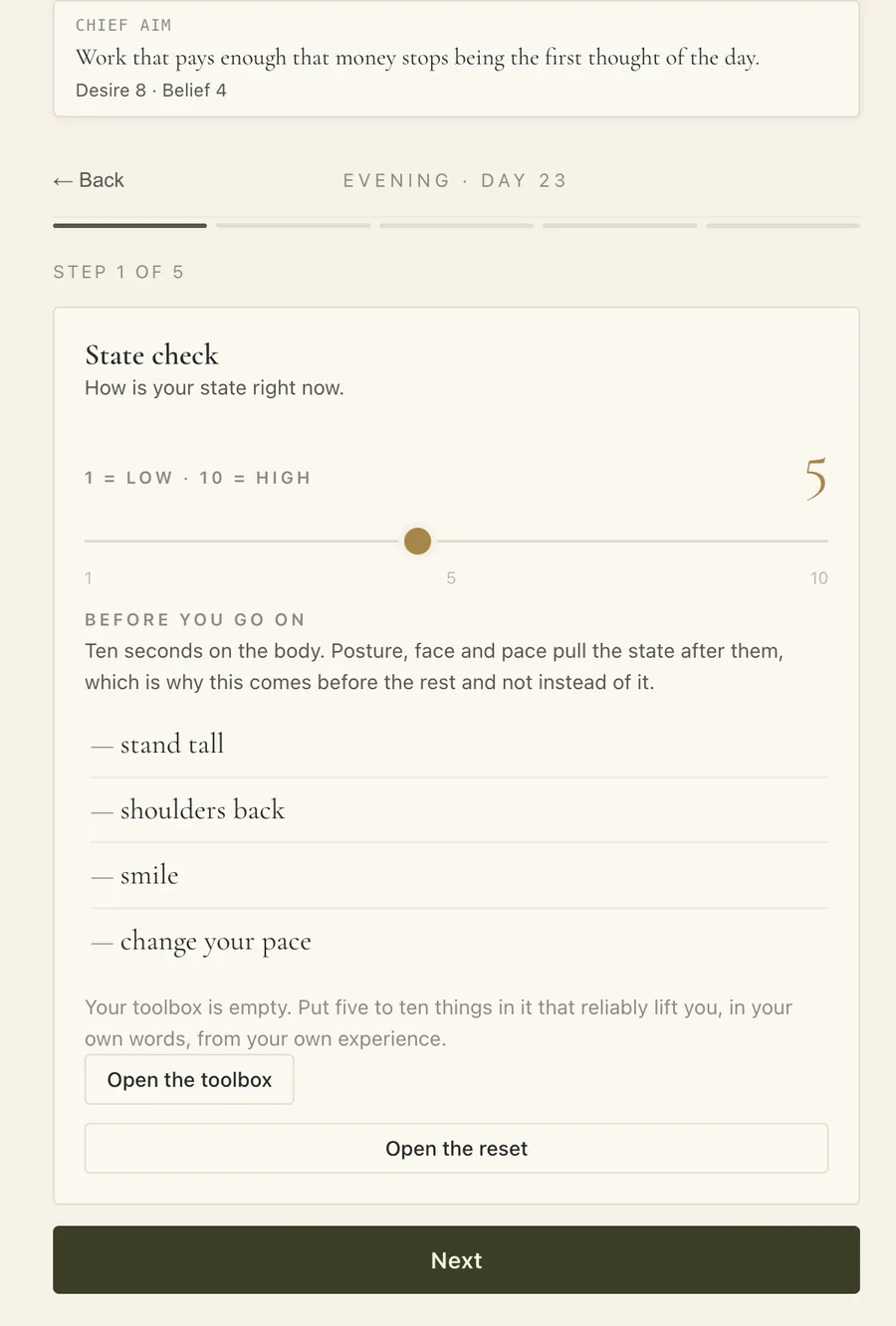
Evening state check, day 23: a slider from one to ten, then four lines on posture before anything else.
The state check, day 23. One number, then ten seconds on the body before anything else.

Two. You push off from a feeling, not a pretty picture.

This is where most people go wrong. They've been told to go straight for the good stuff. But from a flat state you don't get anywhere, and they hold a pretty picture for years with nothing behind it.

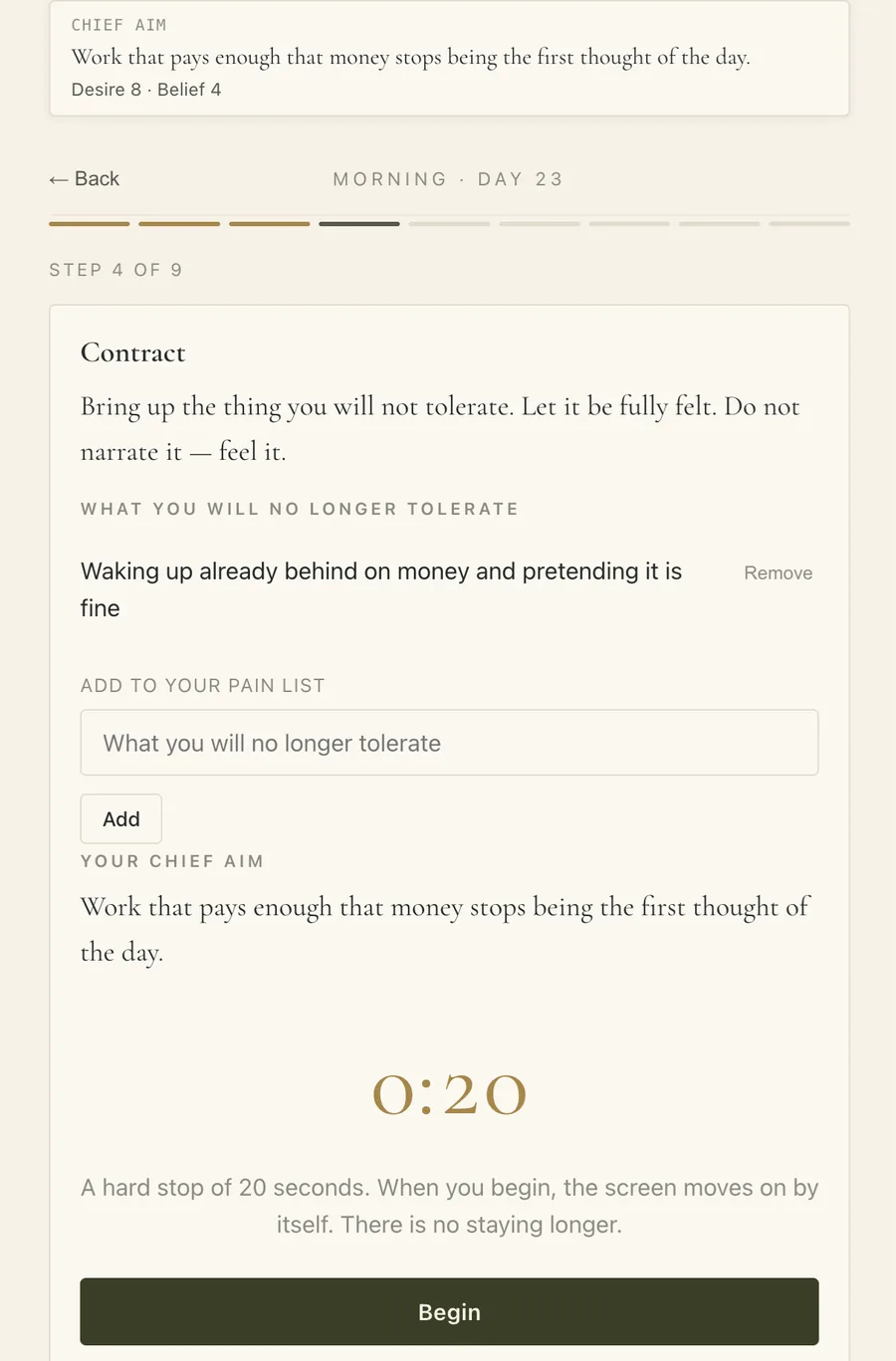
He had me write down everything I wasn't willing to put up with anymore. I filled a page. Now every morning you take this and feel it for twenty seconds. All of it. Don't tell yourself the story. Feel it. Then say it out loud: and what I want instead is…

The first time, I said it out loud in my car in an empty parking lot and felt like an idiot. By the second week my voice had changed. Later he explained it. You already know how to feel something with your whole body. You did it with fear for eight months. Worry is a goal pointed the wrong way. Turn it around.

So every morning here includes twenty seconds of what you won't put up with anymore, felt all the way through. Then you turn. The contraction is the launch. Almost nobody teaches this, and it works.

The contraction screen: your list of what you will no longer tolerate, your chief aim, and a twenty-second timer.
The contraction. Your own list, your goal under it, and twenty seconds that won't wait for you.

Three. You stop canceling yourself out.

A few months in, I set myself a goal: get it all back in a year, and then some. Nothing moved. I started blaming the method, the same way I used to blame my audiences. He asked, How much do you want it, one to ten? Ten. How much do you believe it? I was quiet for a long time. Three.

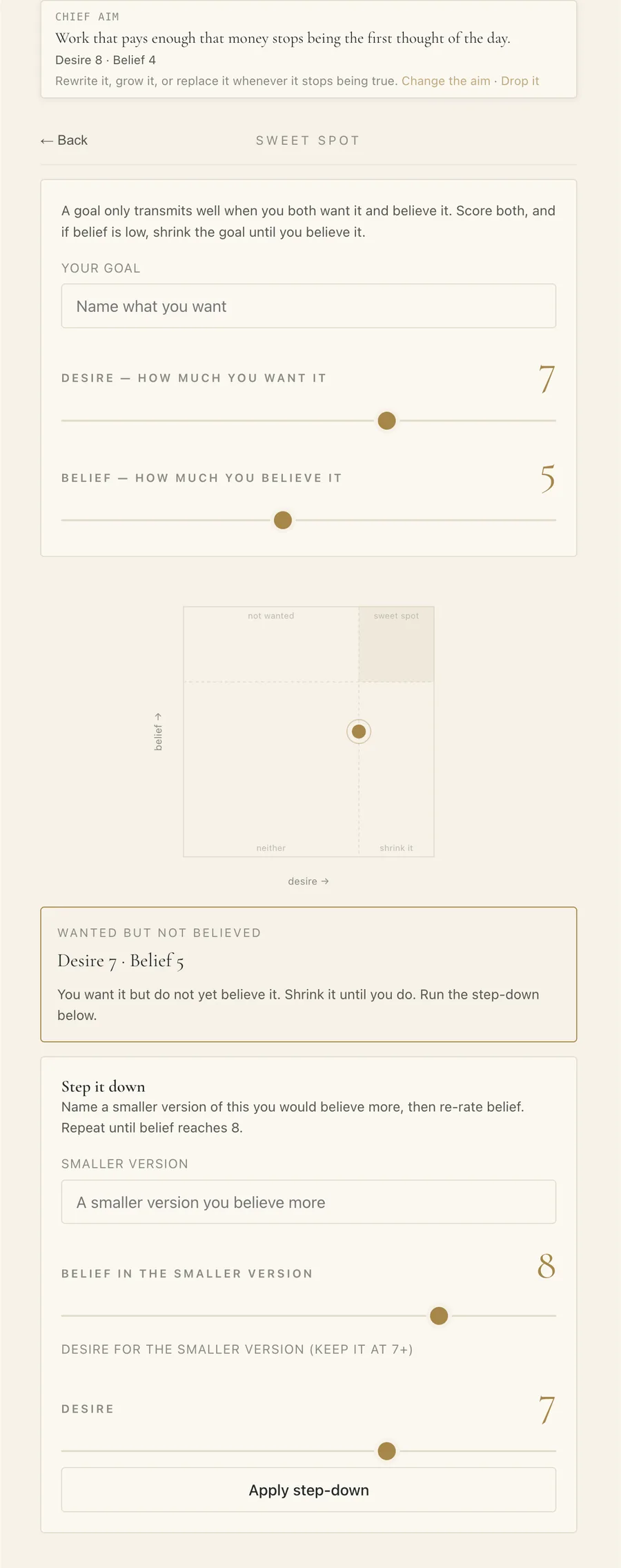
Then you're asking for something you don't believe. Shrink it until you believe it. Then shrink it once more. The dream stays where it is. Only the step moves.

The first goal I believed at a ten was almost funny. Pay off one specific credit card, the smallest one, by the end of the quarter. I paid it off a week early, then sat in my car outside the bank and cried over the smallest debt I had.

Here you don't push the goal higher. You shrink it until you believe it, then climb back up in steps, each one standing on the fact that the last one came true.

The sweet spot: desire and belief sliders, a grid, and a step-down to a smaller goal.
Desire seven, belief five: wanted but not believed. So you step it down until belief reaches eight.

Ninety days isn't a round number picked because it looks good. One practice takes about a month to stop costing you effort, and there are three of them here, laid down in layers.

Why it repeats every day

Something you hear once is just information.

Run into the same truth for the tenth time, each time on a day that proves it, and it stops being something you remember. It becomes something you think with.

That's how he taught me. In pieces. He never explained anything up front. He'd have me do it first, and weeks later he'd tell me what it was. The next piece came when the last one had become a habit, not when I understood it. Where I'm from, we say: the eyes are afraid, the hands do. His order was exactly that. Hands first. Understanding later.

That's why there's a law at the top of every screen, every day, for ninety days.

What you'll read

The reading comes after the doing.

His study was full of books with cracked spines. They'd been read, not put out for show. He never started with a book. Only after I'd been doing something for weeks would he take one off the shelf and open it to the page that explained what my hands had been doing. By then I didn't need convincing. I needed words for something I'd already felt.

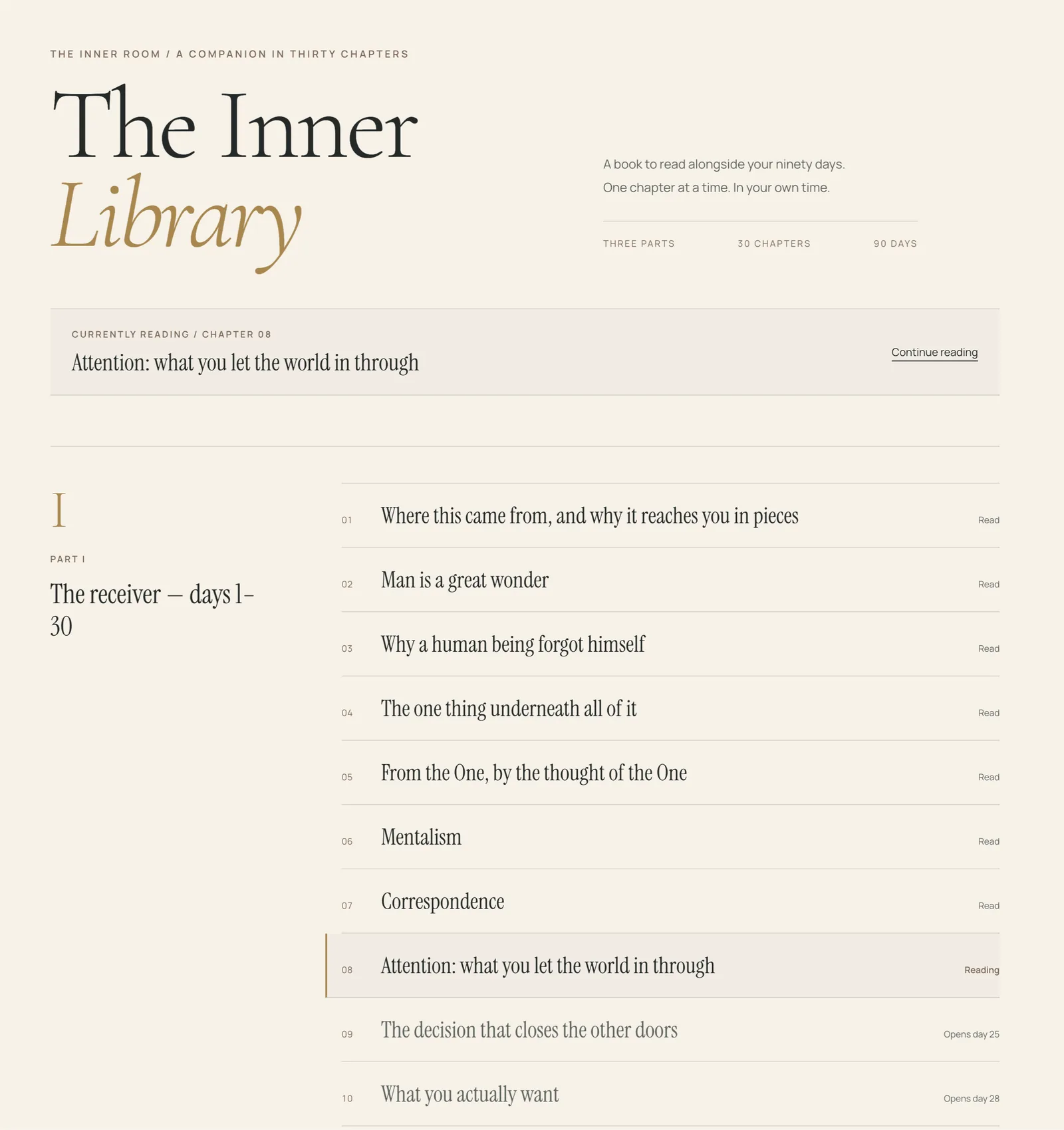
The reading here works the same way. Alongside the ninety days there's a book, The Inner Library: thirty chapters, one for every three days, and a closing one that opens on day ninety. On the day you start, you see the whole table of contents: every title, and the day each chapter opens. A chapter opens on the first of its three days, and it's about those three days, the ones you've already started doing.

The Inner Library: the table of contents, with chapters read, the current one, and the days the next ones open.
The Inner Library. Every title is visible from day one; each chapter opens on its own day.

Every chapter starts with a true story, with a date, a place, and numbers. Then one line from the Hermetic texts, and what in it actually carries the weight. Then why each of your three days is built the way it is. Then the same idea in traditions that never met: the Hebrew Bible, the Gospels, the Quran, the Buddha, the Upanishads, the Tao Te Ching. Sometimes what scientists found centuries later, measuring with no interest in any of it. And at the end, what these three days are asking of you. Each chapter takes less than ten minutes to read.

A few of the titles:

Where this came from, and why it reaches you in pieces.

Man is a great wonder.

Why a human being forgot himself.

The decision that closes the other doors.

The twelve torments.

Rhythm.

Money as a consequence.

Handing it on.

The second title is the line he had me read aloud in his study, from an old Latin text: man is a great wonder. I couldn't get through it. Six months earlier I'd been delivering food. Read it again, he said. Slower.

The closing chapter isn't tied to any days. It opens on day ninety, together with your report, and it's about what comes after.

Chapters don't expire. If you've been away, every one that has opened is waiting for you, and once a chapter opens, it's yours for good. Besides the chapters, there's a short primer you can read before day one or skip, a page at the start of each of the three phases on where you're headed next, and a reference section that's always there.

The law on the screen is what you carry through the day. The chapter is where you find out why.

How a day is built

Six minutes in the morning. Five at night.

Morning.

Your state. A slider from one to ten. Three seconds, no thinking.

The law of the day. One line in big type: the principle the day is built on. Under it, a short paragraph on what you're about to do, why, and how you'll know it worked.

Today's task. One concrete thing, out in the real world.

The contraction. Twenty seconds. The timer is fixed: once you start, the screen moves on by itself, and you can't stay longer.

The turn. One line, out loud if you can: and what I want instead is… and then your goal.

The hold. Ninety seconds of holding your goal as if it's already true.

The release. Breathe out, unclench, put it down.

Your state again. Same slider, after the release.

Gratitude. One line.

Evening.

Your state. Anything that showed up today connected to what you want: a thought, a person, an offer, a coincidence, the thing itself. Did you do today's task? Yes, partly, or no. No is a normal answer, and it's data too. One line on what you noticed, and one line of gratitude.

He had me write that evening line too. At first I only wrote down the big things. He looked at the page and said, Then you're measuring your mood, not your month.

The sit is the middle of the morning, from the contraction to the release, and it can't be skipped. Everything else in the day records what happened. The sit is the one place where something actually gets done.

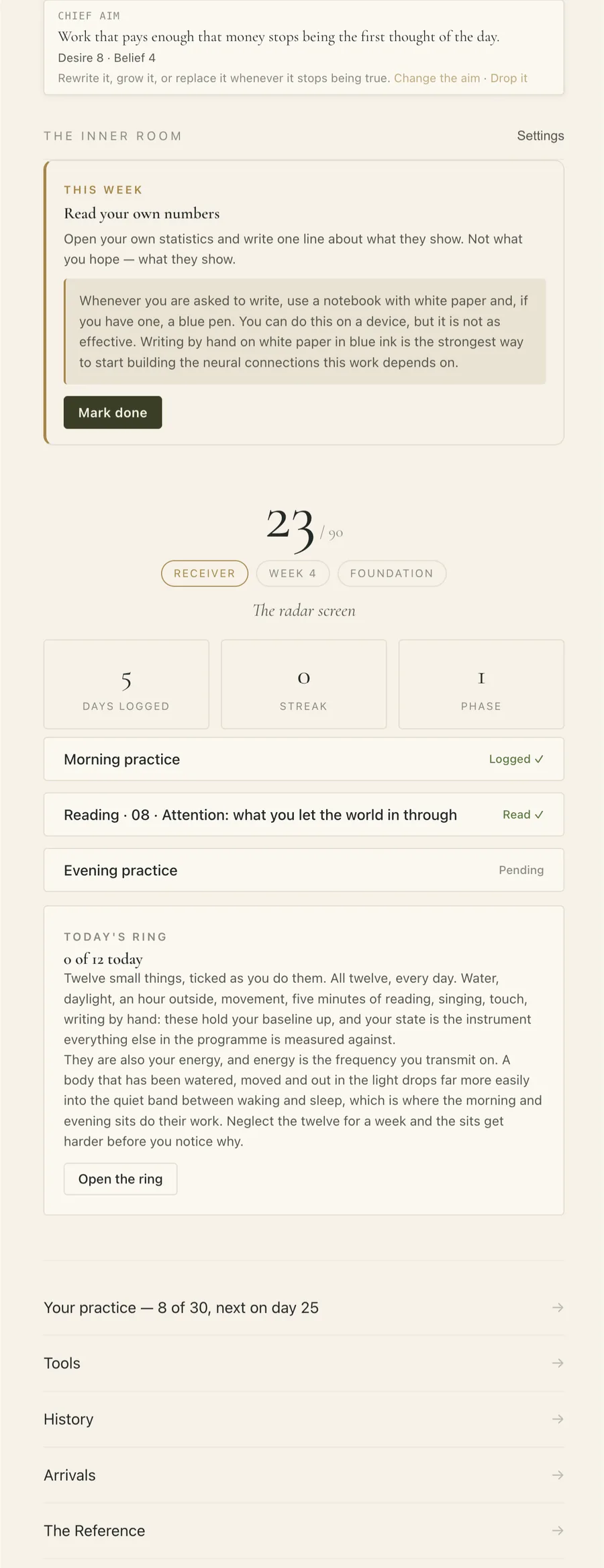
The home screen on day 23: this week's assignment, the morning logged, today's chapter read, the evening pending, and the ring.
Day 23 at a glance: the morning logged, today's chapter read, the evening still ahead.
What else is in there

The ring, the week, the tools, the mirror.

The ring. Twelve daily habits, one tap each. None of them are required, and none of them block your day. Here's the point: completion is plotted on the same axes as your state line, and within a few weeks you see which of the twelve actually moves your number. It's different for everybody. I watched the old man do most of them for a year before I knew they were on a list. A full glass of water before anything else. Ten minutes looking at the horizon. One page of a book. Getting out a mile from home and walking the rest.

The weekly assignment. One piece of work a week that can't be done at a desk. Go stand next to the thing you want. Sit in that car. Walk through that house. Spend real time around someone who already has it, and write one line: what they do that you don't. Give something of value away and tell nobody. He used to send me to sit in the lobby of a big hotel for half an hour and watch people living lives I didn't believe I could have. Sit until it stops burning. If it doesn't stop, leave.

Tools, always within reach. Your own list of what reliably picks you up. It opens by itself whenever you log a four or lower. He made me write mine: walk down to the water, shave slowly, wash the car, call my younger son, one song. Write it while you feel good. When you feel bad, you won't be able to come up with it. Then the reset, a two-minute sequence for when a feeling won't move. The cancel counter: catch the thought, replace it, tap. And the physiology card, four lines, four seconds. The body goes first. The feeling follows it home.

The sweet spot. Desire and belief plotted on one grid. Below eight on belief, and the goal gets shrunk and rated again. The belief ladder: rungs from what you already believe up to what you don't. He told me fear and belief sit on the same ruler. You don't break the ruler. You move along it.

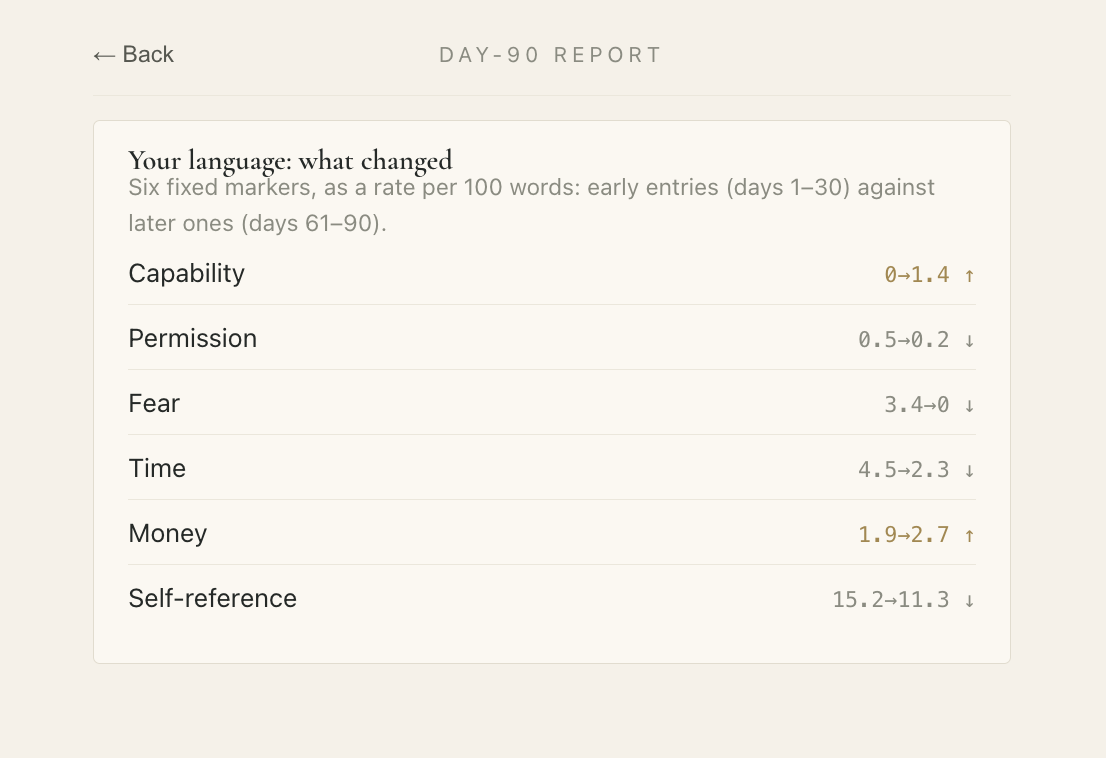
The mirror. Your own writing, counted. How six markers in your language shift between the first month and the last: capability, permission, fear, time, money, and how often you talk about yourself. Nothing gets interpreted. It just gets counted. Your words change before your circumstances do, usually before you notice.

The twelve and the ten. From the same old texts: twelve things that hold a person down, and ten that drive them out. Not a list of sins. A list of states, each one named a very long time ago, and more precisely than we name them today. He gave me the twelve on a card and asked which three were loudest in me. Envy of the people still on stage. Grief. And rashness. Don't fight them. Fighting only feeds them. Bring in the opposite. You don't carry the dark out of a room. You bring in a lamp.

The gates on day thirty and day sixty. A check against your own data. Not a punishment. What comes next is built on what came before, and it won't stand without it.

And the part nobody else builds.

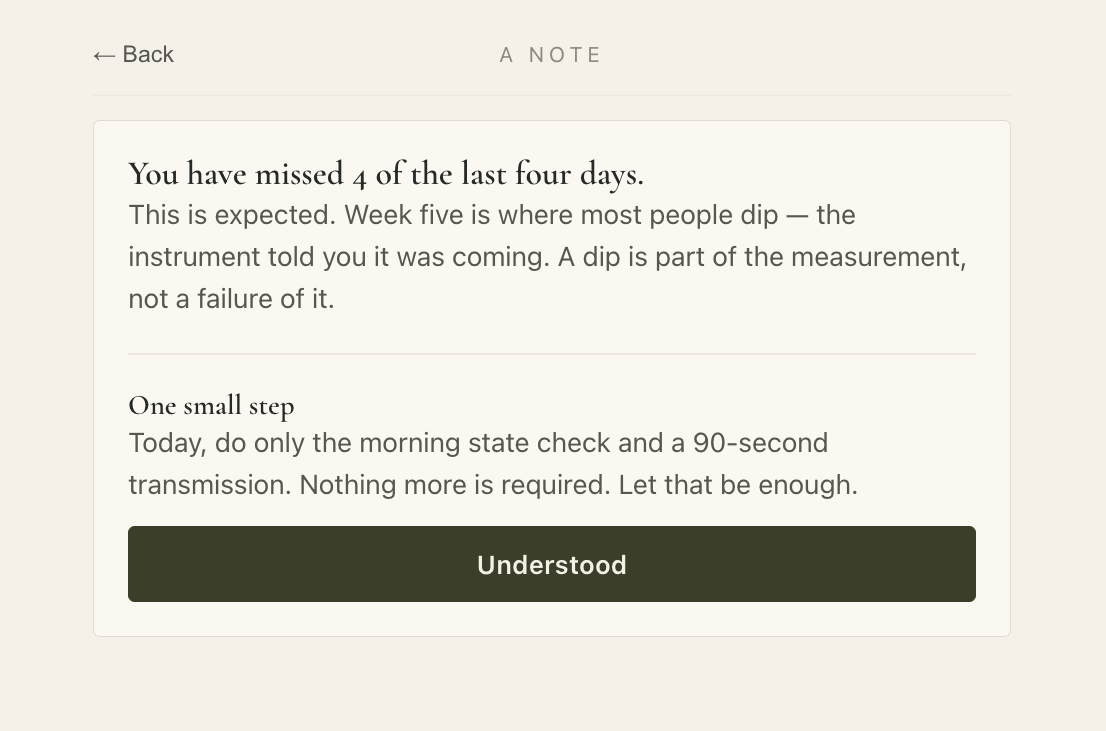
In my first week as his student he told me, Somewhere around week five you'll decide this is all nonsense. In week five I did. I skipped two mornings. The contempt I used to feel for the whole genre came right back. He saw the empty lines in the notebook and said, Right on schedule. That's the pendulum. This is where almost everybody gets off. Tomorrow, just the number and ninety seconds. Nothing else.

Around week five or six, the practice starts to feel pointless and people quit, not because the method failed, but because a flat couple of weeks feels like a verdict. Here you're warned on day thirty-five, while you still feel fine. And when your own numbers say the slump has arrived, the app tells you so plainly and shrinks the day down to almost nothing.

The downswing screen: you have missed four of the last four days. This is expected.
The downswing module. It shows up on its own. One state check and ninety seconds. That's enough for today.
What I promise

This works.

I'm saying it without hedging and without a maybe. It's been handed down for centuries because it works for everyone who actually does it. It isn't about luck or character. It's about how a person is built. It worked on me, and I was a bad candidate: fifty years old, buried in debt, a medical degree nobody here could read, and ten years of already knowing everything.

It'll work for you too. But.

I trained as a doctor, so let me put it in terms I know. It works like a course of antibiotics: you finish it. Not because somebody's being strict about it, but because that's how the thing is built. Stop halfway and you don't get half the result. You get nothing, and then you're sure you were cheated.

So what follows comes in two parts, and they have to be read together. First, what I promise. Right after that, the condition.

What part of this is mine.

The principles aren't mine. I didn't invent them and I didn't improve them. There's nothing in them to improve. What's mine is the order.

None of this was ever locked up. It was scattered. Across old texts nobody opens. Across books where the thing you need is on page three hundred, mixed in with everything you don't. Across people who pass it on by word of mouth, and only to their own. Access was never the problem. The problem is that you can't do it in that form. You read it, you're impressed, and a week later you don't know where to start. Believe me, I know. I built a career on people being impressed.

It only worked for me because a real person was right there, every day, for four years. He gave me one piece, held back the next until the last one had become a habit, and tested me without warning. That person is exactly what almost nobody has.

I can't give you that man. Nobody can. So I built the two parts of him that can be built. The order he gave it to me in. And the eye: something that asks for your number every morning, won't accept a flattering seven, and shows you your own line. An app can't care about you. But it can do what he did. It can watch, and it can count.

You aren't paying for the knowledge. The knowledge is older than all of us. You're paying for the order it can actually be done in, and for something standing next to you every morning that won't let you skip.

What will be true by day ninety.

I'm not promising you a dollar figure. You won't find anybody's income on this page. I'm promising you a different person making your decisions. That's the only thing anyone can actually give you, and everything else grows out of it.

You'll stop waiting.

I spent four months on the edge of the bed waiting for things to go back to the way they were. They don't go back. This is the first thing that changes, and the people around you will see it before you do.

What's holding you back will have a name.

Not "low confidence" and not "bad luck." A specific sentence you say to yourself, and who you first heard it from. Mine was I'm just a driver. I said it on the phone one day, and he heard it from the back seat. When I hung up he said, There's nothing "just" about you. Once a thing has a name, it stops running on its own. The whole second month is built on this.

You'll start seeing what's been right in front of you.

There's nothing mystical about it. Attention is selective, and what it picks up shifts with what you think is possible for you. Every opening that paid off my debt was in plain sight. I wrote them down every evening, one line each, even the small ones, because he told me to.

Decisions will stop costing you weeks.

Good. Now we know. I'd have lost a week over that deal. I lost years over less. I used to think his calm was something you're born with. It isn't. It can be trained, and faster than you'd think.

And you'll know what moves your number.

Which of the twelve, what time of day, what follows what. Not out of a book and not out of somebody else's life. Out of ninety days of your own readings. You can use that for the rest of your life, and nobody will ever be able to sell it to you again.

Money isn't a separate line on that list, and that's on purpose. It sits downstream, behind what you notice, what you ask for, and what you rule out before you've finished the thought. The day I made my last payment, I thought I'd cry. I didn't feel anything special. The next morning I wrote a seven in the notebook, same as the day before. That's when I understood the number had never been about money.

Why I'm sure.

I stood on stage for ten years. Some people got results. Most didn't. I couldn't tell you why, so I decided the ones who didn't just hadn't worked hard enough. Years later, in his study, he explained it in one sentence: You passed on the words and left the weight behind. I was ashamed of how easily I'd blamed those people.

He had the weight. His father had it before him. That family has lasted three generations, and I got to watch what holds it together, from the driver's seat and from across his desk. The tone he used for bad news. The questions he asked people. The things he never did.

What I don't have is a thousand testimonials. I started this from scratch on purpose. It's how I start everything now: with almost nothing, and then I let it grow on its own. I'm not going to show you other people's faces and other people's numbers. The moment somebody starts showing you receipts, receipts are what they're selling. I'm showing you how the whole thing is built, up front, and giving you ninety days to get your own proof instead of somebody else's.

Now the condition

There are two of them. Not one. Both.

The first is doing it right.

Ninety days. Not "more or less" and not "most of it." Exactly as written: both sessions, the sit every morning, the weekly assignment, the gates passed on real data, and not one entry filled in after the fact.

It's not the honor system. The app keeps count. On day ninety your report shows a number: how much of the method you actually ran. Not a feeling. A number.

A month into the notebook, I missed a morning and wrote the number in that night. He tore the page out. That's not a reading. That's a story. That's why the sit can't be skipped and yesterday can't be filled in. Lie to the instrument once and it starts lying back, and you don't have another one.

That's also what the gates on day thirty and day sixty are for. They don't punish. They show whether you were really doing it.

In four years he never once told me I'd done a good job. Later I asked him why. He said praise would have taught me to work for him, and he needed me working for the thing itself. At the time I took it for coldness. It was the only kind of respect that house knew. Nobody handled me with kid gloves, because nobody thought I needed handling.

If you did less than seventy percent of it, the method wasn't tested. You were.

The second is being willing to be changed.

That's the second scale, and it comes back here not as a question but as a requirement.

You can do all of it and change nothing. Someone fills in ninety days neatly, checks every box, never misses once, and stays exactly who they were, because every morning, somewhere inside, they answer I know this and go through the whole thing without letting any of it in. For a while I did exactly that with the old man. On paper I was doing the work. In reality I was digging in my heels, right up until he asked me whether I had the thing.

What letting it in looks like:

When you're told to shrink the goal because you don't believe it, shrink it. Don't talk yourself into believing your case is different.

When a task looks too simple, do it, instead of deciding you're above it.

When a weekly assignment makes you uncomfortable, go stand next to the thing you want anyway and sit with how awkward it feels. The awkwardness is the exercise.

When something you didn't know about yourself shows up in the report, don't argue with the number.

This shows up too. Not on your say-so. Whether you shrank the goal when belief fell below eight, or left it where it was every time. How the six markers in your language moved between the first month and the last. How many times the answer to the day's task was no. Someone who did the work without letting it in can see that in their own report just as clearly as someone who skipped days.

And the other side of the same condition

I don't want your money if it didn't work for you.

If you do the ninety days, the app confirms you ran at least seventy percent of the method, and on day ninety you look at your own lines and see that nothing has changed, write to me. I'll refund every cent. Not just in the first thirty days. On day ninety, after you've done the work.

What it gets measured against.

A one-page report you can export as a PDF. Your state line by week. Arrivals on the same axes. The before-and-after for the practice itself, averaged over ninety repetitions. Task completion and ring completion. Every goal you set and every step down you took, with dates. The six language markers, early against late.

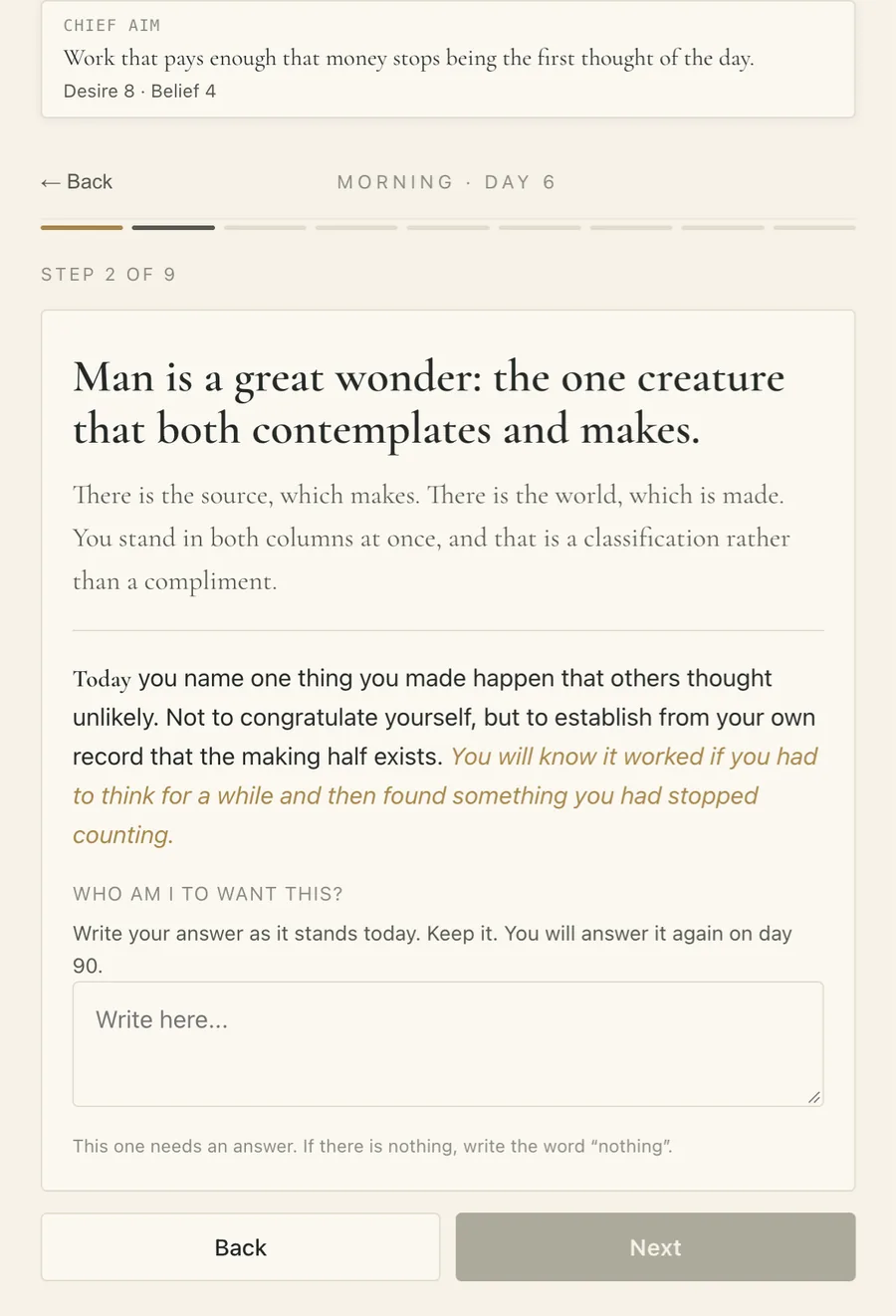
And one more thing, which I took straight from him. In my first month as his student he put a blank sheet of paper in front of me and asked, Who are you to want this? I wrote an answer. He didn't read it. He folded the sheet, sealed it in an envelope, and put it in his desk drawer. We'll come back to this.

He waited three years. On my last day he made me answer the same question again before he'd give me the envelope. I opened it and read my own handwriting: Nobody. A driver. A man who had his chance and blew it. I laid the two sheets side by side on his desk. I didn't recognize the man who wrote the first one. The second answer I don't show anybody. It's mine.

The app asks you the same question on day six. On day ninety it asks again, and puts your two answers side by side.

Morning, day six: the law of the day, and the question: who am I to want this?
Day six. The question he sealed in an envelope. You'll answer it again on day ninety.
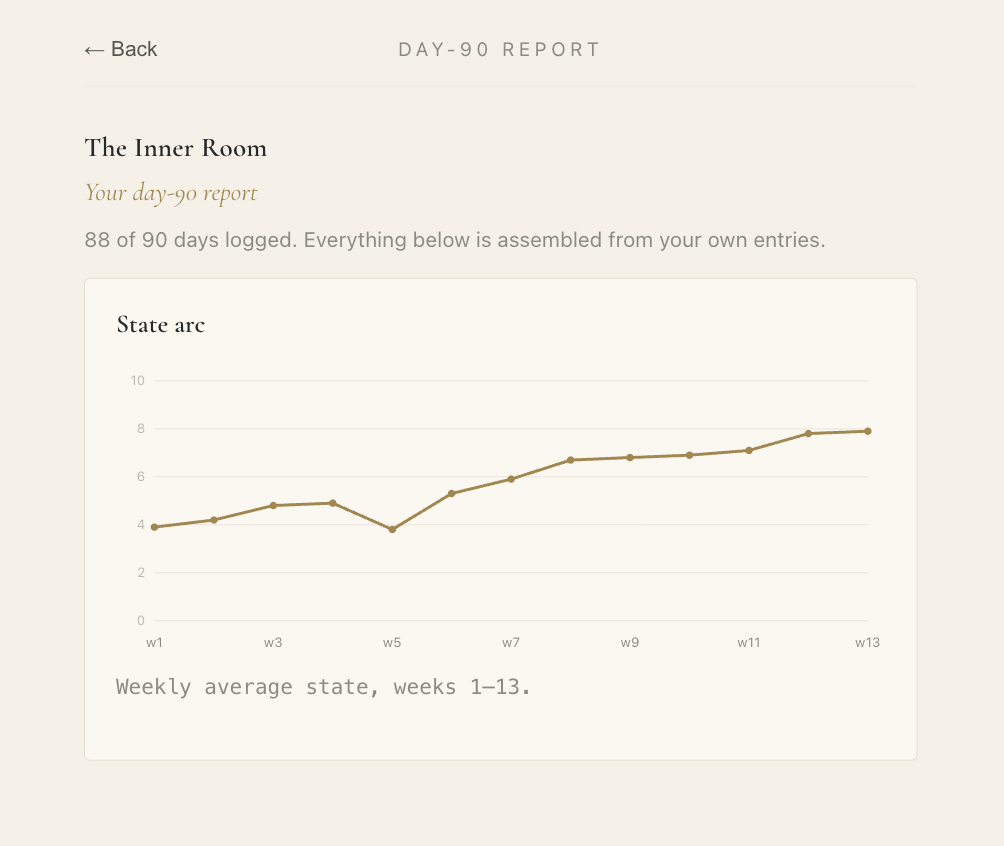
Day-90 report: the state arc by week and arrivals over time.
Eighty-eight of ninety days logged. The state line by week, with week five showing as a dip.
Six language markers, early entries against later ones.
Your own language, counted. Capability 0 → 1.4. Fear 3.4 → 0.

Nobody's asking you to believe. You're being measured.

Two tracks

Foundation, or Deep.

Foundation

About twelve minutes a day. This is the whole method.

Deep

Adds a written prompt, a longer hold, and a daily reading. Thirty to forty minutes.

Deep isn't better. The one you'll actually do is better. You can switch on day thirty and day sixty, and only then.

What isn't here

No coach. No community. No motivation.

No chat and no calls. No subscription: one payment, ninety days. Not one line in here congratulates you for showing up.

I sold motivation for ten years. I know exactly what it's worth by Tuesday morning.

And nobody praises you for what you finish. You already know why.

I don't show my numbers, my house, or my car. Not here, not in anything I post. I spent four years in a house where nobody ever showed off. Old money doesn't shout. It whispers.

Price

One payment. Ninety days.

$49

now, and $79 once the first hundred people are in. For ten years I sold with countdown timers. There's no timer here. One day the price just goes up.

Thirty days

If you change your mind. Day thirty is the first gate, the end of the first part. Run it, look at your numbers, decide it's not for you, write to me, and I'll send your money back. No explanation needed.

Ninety days

If you did the work and nothing changed. That one's harder to earn, and it's the only one that means anything to me.

You get in with a code. There's nothing to set up: no password, no profile. We need your email once, at checkout, so we can send you the code and the login link. It isn't connected to anything you write in the app. The code works on any device, and it's the only key. If you lose both the code and the email it came in, write to us. We'll find your payment and send you the code again.

Questions

Everything people ask before they decide.

Is this religious?

No. The texts it comes from are Hermetic, the Corpus Hermeticum and the writings around it, about eighteen hundred years old and in the public domain. Even they describe themselves as a retelling of something much older. There's nothing to believe in and nothing to join. Not one task in these ninety days asks you to take anything on faith. Everything you'll do, you do with your own hands and check against your own numbers.

I've done seminars, courses, books. Why would this be any different?

I ran those seminars. I know what they're good for. You walk out fired up on a Sunday night, and by Wednesday you're back where you started. A seminar hands you the words. This is the order and the watching, every day, for ninety days, which is exactly what I never gave my own audiences.

How much reading is there?

Less than you'd think. One chapter every three days, under ten minutes each, thirty in all, plus the closing one. On the other days it's the law of the day: one line and a short paragraph. The chapters are where you find out why your days are built the way they are, and why it has worked for as long as it has.

I'm in my fifties. Isn't it a little late?

The first time I started over I was twenty-six, in a country where I barely spoke the language. The last time I was fifty, behind the wheel of somebody else's car. Both times the hard part wasn't my age. It was what I'd decided my age meant.

I don't have ninety days of discipline in me.

A missed day doesn't break anything. Log the next one. What you can't do is fill in yesterday: written from memory, it isn't a reading anymore. And the stretch where you'll want to quit is expected. You'll be warned before it comes.

Do I need to believe in something for it to work?

No. You need to agree to test it. The instrument measures you, not your faith.

What do you mean, it's in our DNA?

That's the old man's line, not mine, and I'll give it to you the way he gave it to me. His father needed twelve years with him. He did it with me in three. He said the difference wasn't in the method. It was in us: people today are built to take this in faster. I can only tell you what I saw. It went faster for me than it had for him, and ninety days is built on that.

Is this about money or about self-improvement?

Money is one of the four areas, and nobody tiptoes around it here. But you don't work on money directly. You work on what you think is possible for you, and money sits downstream of that. In that house the money was downstream. It took me two years to believe it.

Three weeks in and nothing has shown up.

Look at your arrivals log, not your gut feeling. Almost everybody writes down less than actually happens in the first couple of weeks and then remembers the month as empty. He caught me doing exactly that. And ninety days is the length precisely because results in this kind of work usually come late, not never.

Do you guarantee a result?

I guarantee it works, and I back that with money: do the ninety days, get nothing, and you get every cent back. What I can't guarantee is that you'll do it. That's the one part that isn't in my hands, and it's the whole thing. Nobody promised me anything either. I've come to think it wouldn't have worked otherwise.

He gave it to me one piece at a time, over four years.

I've put it in order and fit it into ninety days.

Ninety days once took everything I had. It feels right that ninety days is what I give back.